COACHING TEENAGERS · LEDISA ACADEMY
The parent phones about her fifteen-year-old. This time you say yes.
A specialist certification that ends with your teen practice already built — the eight-session programme, the 81 tools, the consent forms and the parent conversations, written and ready for your first client.
Twelve live Tuesday evenings from 9 March 2027 · COMENSA Gold Training Programme · Free bridging sessions from 18 February if you are not yet a certified coach
THE CALL YOU KEEP HESITATING OVER
You have had this phone call
A mother rings. Her fifteen-year-old has stopped doing homework, stopped seeing friends, stopped talking. The school has suggested someone to talk to. Somebody gave her your name.
And in the three seconds before you answer, you are running the arithmetic.
Who is the client here — the boy, or the woman paying? Who signs the agreement? What do you tell her after the first session, and what stays between you and him? What do you do if he tells you something that frightens you? Can you even take this, or should you pass it to someone else?
You are not hesitating because you cannot coach. You are hesitating because a teenager is not a short adult, and you know it.

WHAT HAPPENS INSTEAD
So the enquiry goes somewhere else
Sometimes you refer it on, and it lands with someone who has no safeguarding training, no consent process and no idea what to do when a sixteen-year-old discloses something serious. That is not a comfortable thought.
Sometimes you take it, and spend the week before the first session inventing a structure from nothing. A worksheet you half-remember. A model you adapted from adult work and hope will land. Nothing to hand the parent. Nothing to leave with the teenager. No record of what was agreed, by whom, or when.
And then you do it again for the next one, differently.
Parents are searching. Schools are referring. The demand is arriving whether you are ready or not — and every month you are not ready is a month of enquiries going to someone who may be less ready than you.
That is not a knowledge gap. It is a systems gap, and no amount of general coaching skill closes it.
THE WEEK YOUR CERTIFICATE ARRIVES
Picture the first Tuesday after you certify

The same phone call comes. This time you do not hesitate, because you know what happens next — and because the practice system was released to you the day you certified.
You send the parent an intake pack that already exists — screening questions, the consent form, the assent form a teenager signs for himself, and a one-page explanation of what you will share with her and what you will not. She reads it and relaxes, because somebody has clearly thought about this before.
The boy arrives for session one. He is monosyllabic and wants to be somewhere else, and you are not thrown, because you were taught how teenagers test a new adult and you are not going to fail that test by filling the silence.
You open his workbook — his own, written in his language, not yours — and he takes it home. Over eight sessions he works through confidence, pressure, friendships and what he might do next. You know what session six is before you get there.
At the review, his mother asks how he is doing. You give her the review form you always give, which tells her what she needs and protects what he said. She thanks you. He keeps the workbook.
Then you do it again with the next client. The same structure. A different young person.
That is what you are buying. Not a certificate — a practice that runs.
THE HONEST COMPARISON
Why this takes twelve weeks when a weekend course would give you a certificate on Sunday
You can buy a teen coaching certificate online this afternoon. A few hours of video, a multiple-choice quiz, a PDF with your name on it by the evening. It costs very little and it is quick, and we are not going to pretend otherwise.
Here is what you would not have on Monday morning.
You would not have a consent process that works when a minor cannot legally consent alone. You would not have an answer for the mother who asks what her daughter said. You would not know where coaching ends and referral begins, or how to make that call without damaging the relationship or frightening the parent. And you would not have a single document to put in front of a client.
Twelve weeks is not padding. It is twelve two-hour evenings with a cohort, a practical portfolio you have to pass, and a complete practice system handed over on certification.
The length is the product.
If a certificate by the end of the month is what you want, buy the weekend course. It will be cheaper and it will be faster, and this page is not for you.
WHAT CHANGES
What you will be able to do
Take the teen enquiry you currently decline — with a screening process, a consent pathway and a first session that works, instead of a week of improvisation.
Hold the parent conversation without breaking the teenager's trust — a written framework covering what you share, what stays private, and how you explain the difference before coaching begins.
Recognise when a teenager needs more than coaching — and refer without damaging the relationship or alarming the parent
Handle consent properly for a minor — parent consent, teenager assent, confidentiality limits and safeguarding, on forms that already exist.
Know exactly where your scope ends — and say why, in writing, when a parent asks.
Run a structured eight-session programme from day one — rather than designing a new one for every client.
Adapt for a thirteen-year-old and a seventeen-year-old — including what changes legally the day a client turns eighteen mid-programme.
Charge with confidence for a programme — because you are offering an eight-session pathway with a workbook, not an hourly conversation
THE PRACTICE SYSTEM
What you leave with
During training — the training pack
Three documents — made available from day one and gradually as we progress through the modules.
Learner Guide
The theory: the coaching role, adolescent development, ethics, boundaries, practice design.
Coach Workbook
Where it becomes practical. Exercises, case work and tool practice for all twelve modules.
Learner Assignment Instrument
Your portfolio assignment, with every task and the marking standard stated up front.
On certification — the practice system
Six documents, 1,402 pages, yours on certification — written, aligned and ready for your first client.
Implementation Guide
How to prepare before session one: screening, consent, assent, privacy, referral readiness.
Teen Coaching Programme Pack
The eight-session programme, session by session.
Teen Coaching Tool Pack
81 tools — consent records, assent forms, screening checklists, session notes, referral records, coaching instruments.
Teen Client Workbook
The teenager's own book, in their language. Yours to give to every client.
Parent / Guardian Communication Pack
Letters, review forms and the conversation scripts for the parent side.
Master Session Alignment Table
One view of how every session, tool, workbook section and parent touchpoint connects.
Four of these come as editable Word files, so you can brand and adapt them for your own practice.
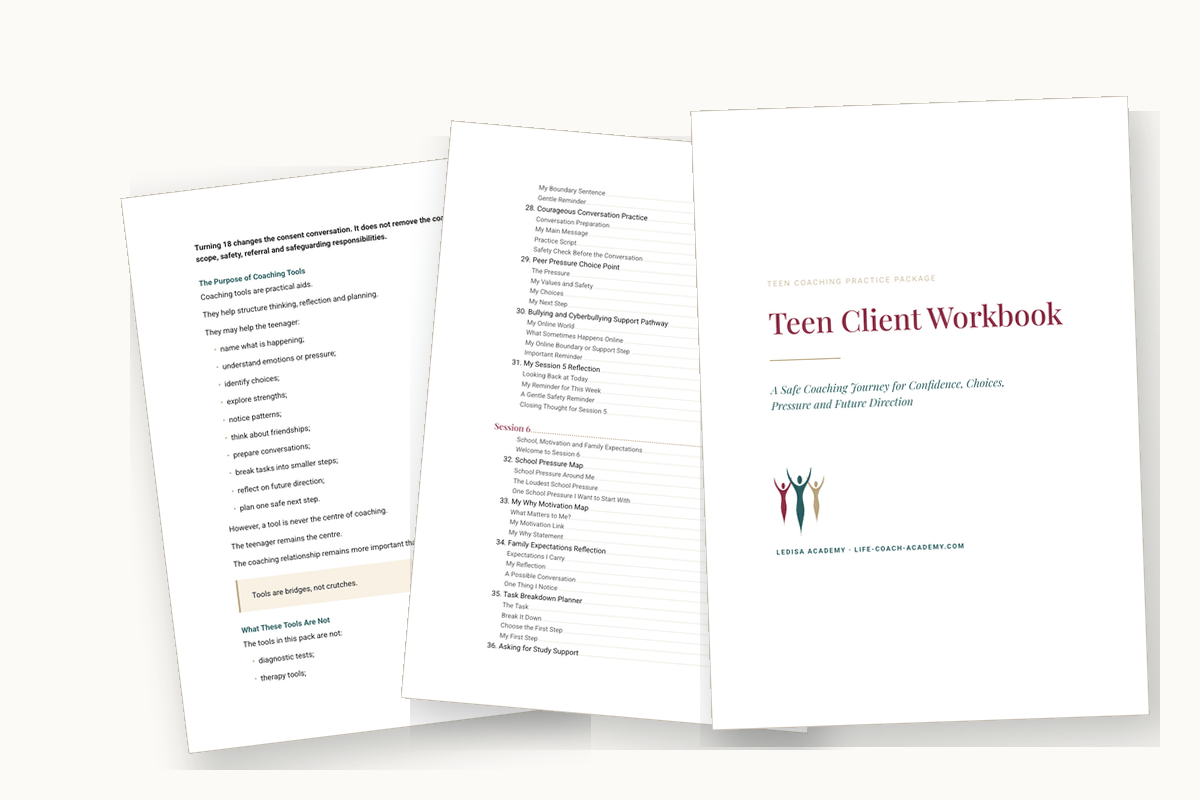
The fee covers all the training material, including audios and videos where applicable, your assessment and certification, nine months in the Online Study Centre, every template your practice needs — fully customisable — and a teenager brain profile showing how a teenager takes in information, learns, communicates and makes decisions.
Then the free starter kit — this is where practice-building starts while you train rather than after you qualify. Free Coach Circle membership of the Leadership Foundation. Business in a Box — website, website builder, email marketing, marketing automation, online course builder and sales funnels, hosting included, domain bought separately. Your first twelve months’ COMENSA registration as a learner coach. Help opening and building your practice. And your New Client Coaching Success Kit.
PROOF
What we can show you, and what we cannot
This is a new certification and its first cohort has not finished, so there are no graduate testimonials yet and we are not going to invent any.
What we can show you is the Academy behind it.
“The way Dr. Leon kept me inspired was remarkable. He has a gift to see the best in those he teaches and mentors.”
— Chantel N
“Leon is for sure an excellent coach and trainer. Thanks for the effort. You are a great inspiration.”
— Mala James
Both from delegates on other LEDISA certifications. What is new here is the teen specialisation, not the people teaching it.
The accreditation is specific to this programme
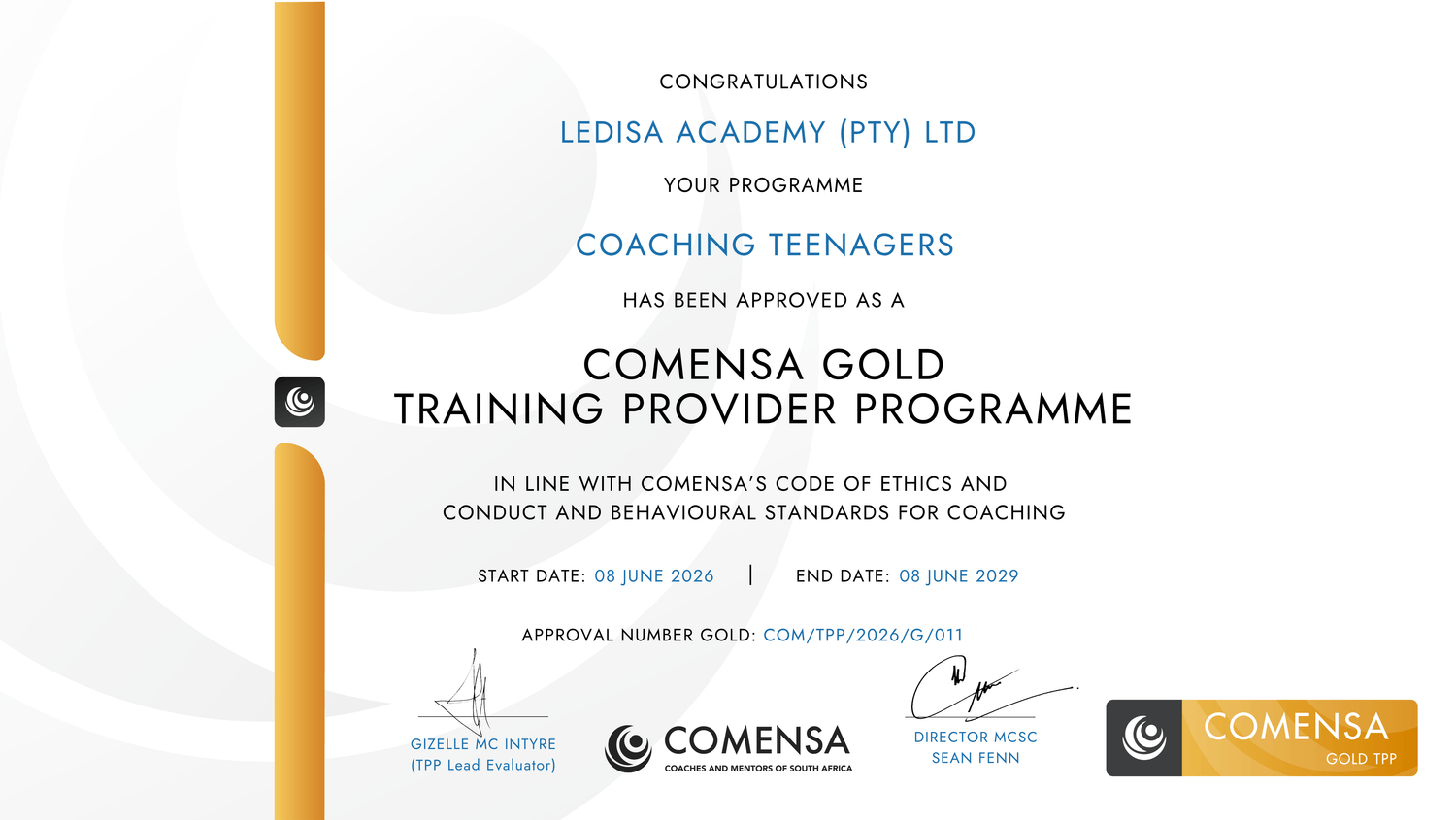
Coaching Teenagers is registered with COMENSA as a Gold Status Training Programme in its own right — approval number COM/TPP/2026/G/011, valid to 8 June 2029. Not a company badge borrowed for a new course. This course, approved on its own merits.
On certification you can register with COMENSA and with the International Coaches Register as a life coach, and add Coaching Teenagers to your professional profile.
The charter cohort
You are joining first. In exchange I will ask you for an honest testimonial once you have coached your first teen client — good or otherwise.
WHO IS TEACHING YOU
Two facilitators, and an independent assessor

LEAD FACILITATOR
Shawna Stapel
Shawna presents most of the twelve modules. A Master Life and Business Coach and certified Teen Coach, she spent fifteen years in education before coaching, founding and running two cottage schools. As a certified NBI Brain Profiling Practitioner she takes you through the teenager brain profile included in your fee, and she is registered with COMENSA.

PROGRAMME AUTHOR
Dr Leon Pienaar
Leon wrote this programme. Founder of LEDISA Academy and a Master Life Coach, he has spent years training coaches from South Africa and around the world, from New Zealand and Australia to Canada and Dubai. He facilitates the practical tasks through the programme, and helps you open your practice through the Leadership Foundation at the end.
Your final assessment is marked by neither of them. An independent assessor is appointed for it, so the people who taught you are not the people who decide whether you pass.
THE TWELVE WEEKS
What the weeks do to you
Weeks 1–4 · You stop guessing
You learn what a teen coach actually is, how adolescents develop, and why trust has to come before any technique. By week four you have tools that work with a fifteen-year-old and you know when not to reach for them.
Weeks 5–8 · You stop being frightened
Anxiety, bullying, body image, friendship collapse, academic burnout. You work through what teenagers actually bring, and — this is the part that changes things — exactly where each one stops being yours to coach.
Weeks 9–12 · You build the practice
Career conversations, the ethics and legal ground of working with minors, and then the two modules where you design your own programme and work out how to fill it. You finish with a practice, not a plan to make one.
HONESTLY
Is this for you?
This is for you if
You are a practising coach who keeps turning teen enquiries away
You are adding a second specialisation with its own referral sources
You work with adolescents already — teaching, youth work, pastoral care — and want a coaching methodology with proper boundaries
You want to start coaching and want to work with young people specifically
You would rather be slower and safe than fast and exposed
This is not for you if
You want a certificate by the end of the month
You cannot commit to twelve consecutive Tuesday evenings
You want to counsel teenagers rather than coach them — that is a different qualification and we will tell you so
You are looking for the cheapest teen coaching credential available
You want to be handed clients rather than taught to find them
INVESTMENT
What does it cost?
If you are already a certified life or business coach
OPTION
ONCE-OFF
PAYMENT OPTION
Certified coach rate
R9,900
R9,900 — 4 × R2,475/month
R9,900 — 9 × R1,100/month
If you are not yet a certified coach
You pay the standard rate and attend three free bridging sessions before the programme begins — fifteen sessions in total, at no extra charge for the three.
OPTION
ONCE-OFF
PAYMENT OPTION
Standard rate
R10,900
R10,900 — 4 × R2,725/month
R10,900 — 10 × R1,090/month
International delegates — an evergreen self-paced video course at $595.
Payment terms are available provided your account is settled before final certification. On payment terms, your teenager brain profile and COMENSA learner registration are arranged after your second monthly payment. Coach Circle membership starts after the induction for everyone.
RISK REVERSAL
We will not leave until you are certified
The fear here is not usually “is this worth the money”. It is “can I actually do this” — the portfolio, the assessment, coaching a real teenager.
So the guarantee is about getting you there, not about getting your money back.
In thirteen years of certifying coaches, every delegate who has submitted their assignment has been certified.
That is not a low pass standard. It is what happens when nobody is allowed to fail quietly.
Here is the mechanism behind that number.
You have three months after the final module to submit your practical assignment. If it comes back not yet competent, you do not fail and disappear. You get, in this order:
A full written feedback report against the assessment rubric, section by section, so you know exactly what is missing and why.
A one-on-one development session with a Master Coach — before you resubmit, not after you fail again.
One resubmission, included
Three months in which to make it.
No resubmission fee. No charge for the development session. Both are part of what you paid for on the day you enrolled.
And the certification itself is independently recognised.
Coaching Teenagers is registered with COMENSA as a Gold Status Training Programme in its own right — approval number COM/TPP/2026/G/011, valid to 8 June 2029. You are not taking our word for the standard.
BEFORE YOU ASK
Questions and answers
You can adapt the conversation. You cannot adapt the consent. A minor cannot give sole consent to coaching, the parent's role has to be defined before you begin, and confidentiality works differently when the client is fifteen. Those are structural, not stylistic — and getting them wrong is where coaches get into real trouble.
Yes. There are no minimum entry requirements. As a bonus, you begin with the first three Dynamic Life Coaching sessions, free of charge, as an introduction to coaching. Then you start the twelve specialist modules with everyone else, and you finish certified as a Teen Coach.
That is fine. Any recognised coaching certification qualifies you for the certified-coach rate. You do not need to have trained with us.
Modules 7 and 10 cover exactly this — recognising what sits beyond coaching, what your duty is, how to refer without damaging trust, and how to document it. You will not be improvising.
The programme covers ages 13 to 17, and what changes when a client turns 18 mid-programme, including the adult-consent reset and the form for recording it.
This one is live and assessed. Twelve scheduled evenings with a cohort you will know by name, a portfolio to submit, and a pass standard. You will finish it or you will not certify — and the certification is the point.
It is 24 hours of live teaching plus the portfolio, and you are not expected to memorise it all. You are expected to know what to use and when — which is why you leave with the Implementation Guide and 81 tools rather than a set of notes.
2027
Intakes
First Intake
Bridging
Thursdays 18 February, 25 February and 4 March 2027
Programme
Twelve Tuesdays, 9 March to 25 May 2027
Already-certified coaches begin Tuesday 9 March
Second Intake
Bridging
Thursdays 2, 9 and 16 September 2027
Programme
Twelve Tuesdays, 21 September to 7 December 2027
Already-certified coaches begin Tuesday 21 September
All sessions 19:00–21:00 South African time, live on Zoom. Sessions are recorded for anyone who misses one, but this is a cohort and the value is in being there.
After the final module you have three months to submit your practical assignment. Study Centre access runs for nine months from the start of the programme, so it is open throughout the programme and well past your submission date.
Twelve Tuesday evenings between you and a teen coaching practice
R9,900 for certified coaches, R10,900 standard — payment options available. First intake begins 18 February 2027. Already-certified coaches start on Tuesday 9 March 2027.
P.S. — The mother who phoned you last month found another coach. So will the next one, unless something changes before she calls. The difference between referring that enquiry on and being the person it was meant for is twelve Tuesday evenings and a system you do not have to build yourself. The first intake begins on 18 February, or 9 March for certified coaches, and the course runs twice in 2027 — that is it.
© 2026 LEDISA Academy (Pty) Ltd · Privacy Policy · Terms of Use · Cancellation Policy