
Coaching Teenagers —
A Specialist Life Coach Training Programme
“When a teenager is heard, guided and supported with wisdom, their challenges can become stepping stones toward confidence, clarity and growth.”
Coaching teenagers is not the same as coaching adults, and most coaches know it the moment a parent phones about a fifteen-year-old. Who consents? What do you tell the parent afterwards, and what stays private? Where does coaching stop and something more serious begin? Coaching Teenagers is a twelve-module specialist certification from LEDISA Academy that answers those questions properly. You learn how adolescents actually develop, how to build trust with a teenager who did not choose to be there, how to involve a parent without turning coaching into surveillance, and how to recognise the point where referral is the responsible choice. You finish with a structured coaching programme, a teenager's own workbook and a parent communication pack already written — ready for your first client.
Coaching teenagers and counselling a teenager — the difference
A teenager who is struggling may need a counsellor, a psychologist, a doctor, a school intervention — or a coach. These are not the same thing, and a safe teen coach can tell the difference.
Counselling and therapy work with diagnosis, treatment, healing and psychological repair. They look backwards into history, trauma and mental health conditions, and they are delivered by registered professionals working within a clinical scope of practice.
Coaching teenagers works forward. It helps a young person think clearly, build confidence, make decisions, handle pressure and take their next step. It does not diagnose, it does not treat, and it does not replace clinical care.
The distinction matters more with teenagers than with any other client group, because a minor cannot give sole consent, a parent has a legitimate role, and a sixteen-year-old may disclose something in a coaching session that nobody else has heard. This programme teaches you exactly where your lane is, how to explain it to a parent before coaching begins, and what to do the day a teenager says something that falls outside it.
Referral is responsible practice, not failure.
Coaching Teenagers learning outcomes
At the end of the Coaching Teenagers programme, delegates should be fully conversant with and be able to apply the following:
Explain the role, scope and ethical boundaries of a teen life coach.
Distinguish teen coaching from counselling, therapy, teaching, parenting, tutoring, mentoring and crisis intervention.
Describe the developmental, emotional, social and practical realities that shape adolescent behaviour.
Build safe, trust-based coaching relationships with teenagers who did not choose to be in the room.
Create emotionally safe coaching spaces and hold appropriate role clarity.
Use teen-sensitive coaching tools responsibly and flexibly, including the T.R.E.K. Framework™.
Identify common teenage challenges that are suitable for coaching support.
Recognise concerns that fall outside coaching scope and require referral, safeguarding or additional support.
Support teenagers with relationships, friendships, peer pressure and boundaries.
Apply mental health awareness and emotional regulation support within coaching scope.
Support teenagers through academic pressure, motivation, perfectionism and burnout.
Guide career exploration without becoming directive or replacing specialist career guidance.
Explain confidentiality, privacy, consent, teen assent and safety limits clearly to both a teenager and a parent.
Communicate with parents and guardians responsibly, without turning coaching into reporting.
Design a structured teen coaching pathway that protects the teenager's wellbeing while allowing flexibility.
Build and grow a responsible teen coaching practice within ethical, legal and professional limits.
Who should attend?
Practising life coaches who keep referring teenage enquiries away and want to take them instead.
Certified business, career and executive coaches adding a second specialisation with its own client base and referral sources.
People entering coaching for the first time who want to work specifically with young people. No prior coaching qualification is required — see entry requirements below.
Counsellors, pastoral workers and youth workers who want a structured, ethical coaching approach alongside their existing role.
Teachers, school support staff and learning support practitioners who work with adolescents daily and want a coaching methodology that stays inside a school's boundaries.
Parents, guardians and foster carers who want to understand the teenage developmental picture properly, whether or not they go on to practise.
Sport, performance and music coaches working with teenage athletes and performers, where pressure, identity and motivation are the daily work.
Social workers, child and youth care workers who want a forward-looking coaching skill set to sit alongside statutory work.
Minimum entry requirements
No minimum entry requirements apply. Anyone may enrol.
Certified life or business coaches pay a reduced fee and attend the twelve specialist sessions only.
Applicants who are not yet certified coaches join the first three Dynamic Life Coaching sessions as a free bonus: an introduction to coaching before the twelve specialist sessions begin. Fifteen sessions in total. On completion you are certified as a Teen Coach.
Course fee inclusions
All training material, including audio and video where applicable.
Assessment and certification.
Entrance to the Online Study Centre for nine months.
All templates needed for your coaching practice — fully customisable.
A teenager brain profile, showing how a teenager naturally processes information, learns, communicates and makes decisions.
Free starter kit
Free Coach Circle membership.
Business in a Box — a one-page website with website builder, email marketing, marketing automation, online course builder and sales funnels. Hosting is included for as long as the website stays active on ledisaweb.com. The domain name is purchased separately through the LEDISA registrar, and the website content is supplied by you.
First twelve months' COMENSA registration as a learner coach.
Assistance with opening and building your practice.
Your New Client Coaching Success Kit.

Coaching teenagers course outline
The programme is a progressive competence pathway. Learners move from foundational understanding, to applied coaching with real teenage challenges, to ethical and professional readiness for practice. The twelve modules are grouped into three developmental phases.
Phase One · Foundations of Teen Coaching (Modules 1–4)
Establishes the knowledge, posture and skills required before a learner meets a complex teen coaching scenario.
Module 1 — Welcome to Teen Coaching Specialisation
Teen coaching as a specialist field
What teen coaching is, and is not
Why teenagers are not short adults
The posture of a safe teen coach
Parent and guardian involvement
Referral awareness
Module 2 — The Teenage Mindset and Developmental Journey
The teenage brain under construction
Emotional intensity
Identity formation
Peer influence and belonging
Impulse control and risk-taking
Digital identity and online pressure
Behaviour as communication
Module 3 — Building Safe and Trust-Based Coaching Relationships
Trust comes before technique
How teenagers test trust
Behaviours that build and damage trust
Respecting silence and pace
Permission-based questioning
Confidentiality and its limits
Trust repair
Module 4 — Essential Coaching Tools for Teens
What makes a tool teen-friendly
The T.R.E.K. Framework™
Choosing the right tool
Avoiding tool overload
Debriefing a tool
When a tool reveals something serious
Phase Two · Modern Teen Challenges and Applied Coaching (Modules 5–8)
The real-world concerns teenagers bring into coaching, and how to respond ethically and practically while staying within scope.
Module 5 — Common Challenges Faced by Teen Clients
Listening beneath the words
Low self-esteem and negative self-talk
Body image and appearance pressure
Social media comparison
Bullying and cyberbullying
Loneliness and social isolation
Family conflict and communication gaps
Module 6 — Coaching Teens Through Relationships and Friendships
Peer belonging and fear of rejection
Friendship pain, betrayal and exclusion
Cliques, popularity and social hierarchies
Group chats and online conflict
Manipulation, guilt and control
Boundaries in friendships
Dating, crushes and first relationships
Module 7 — Mental Health and Emotional Regulation
Coaching support versus mental health treatment
Helping teenagers name emotions
Anxiety-related concerns
Depression indicators
Emotional overwhelm and shutdown
Grounding and calming strategies
The coach's emotional steadiness
Module 8 — Academic Pressure and Motivation
Performance identity and fear of failure
Exam stress and test pressure
Perfectionism and overachievement
Procrastination and academic avoidance
Academic burnout
Parent and guardian expectations
When academic pressure requires referral
Phase Three · Professional Judgement and Practice Readiness (Modules 9–12)
Integrating teen coaching knowledge into ethical, structured, responsible professional practice.
Module 9 — Career Coaching for Teenagers
Exploration, not prescription
The fear of choosing wrong
Subject-choice pressure
Family and cultural expectations
Strengths, interests and values discovery
Traditional and non-traditional pathways
Module 10 — Ethics, Boundaries and Legal Considerations in Teen Coaching
Working with minors
Confidentiality is not secrecy
Consent and teen assent
Turning 18 during a coaching programme
Digital communication and social media
Responding to serious disclosures
Safeguarding, referral and record keeping
Module 11 — Designing Your Teen Coaching Programme
Why structure matters
Structured does not mean scripted
Intake and readiness
Parent or guardian onboarding
Planning session themes
Progress review
Closure and continuation
Module 12 — Growing a Practice That Serves Teens
Defining a teen coaching niche
Explaining teen coaching to parents and to teenagers
Ethical marketing language
Protecting teen privacy
Building referral networks
Working with schools and organisations
Supervision and professional development
What you receive for your practice
Most specialist certifications give you knowledge and leave you to build the delivery yourself. Coaching Teenagers ends with the delivery already built. On certification you receive a complete practice system:
Implementation Guide — how to prepare before session one: screening, consent, assent, privacy and referral readiness.
Teen Coaching Programme Pack — a structured eight-session coaching programme, session by session.
Teen Coaching Tool Pack — 81 coach-facing tools: consent records, assent forms, screening checklists, session notes, referral records and coaching instruments.
Teen Client Workbook — the teenager's own book, written in their language. Yours to give to every client.
Parent / Guardian Communication Pack — letters, review forms and the conversation scripts for the parent side.
Master Session Alignment Table — one view of how every session, tool, workbook section and parent touchpoint connects.
Four of these are supplied as editable Word documents, so you can brand and adapt them for your own practice.
Coaching Teenagers certification process
Completion of enrolment form.
Confirmation and billing.
Booking of seat / payment of fee or deposit.
Onboarding emails and entrance to the Online Study Centre.
Online contact session attendance via Zoom, once a week for twelve weeks.
Practical assignment.
Submission of assignment.
Assessment. (Your final assessment: An independent assessor is appointed for it, so the people who taught you are not the people who decide whether you pass.)
Certification.
On certification you may register with COMENSA and/or the International Coaches Register, and add Coaching Teenagers to your professional profile.
Training approach and schedule
Approach — live online contact sessions via Zoom, supported by the Online Study Centre.
Duration — twelve weekly sessions of two hours each. Delegates who are not yet certified coaches add three bridging sessions beforehand, making fifteen.
Session time — 19:00–21:00 (South African time).
Assessment — practical portfolio assignment, submitted after the final module.
Study Centre access — nine months.
International delegates — an evergreen self-paced video course is available.
Training dates for 2027
First Intake
Bridging — Thursdays 18 February, 25 February and 4 March 2027.
Programme — twelve Tuesdays, 9 March to 25 May 2027. Already-certified coaches begin on Tuesday, 9 March 2027.
Second Intake
Bridging — Thursdays 2, 9 and 16 September 2027.
Programme — twelve Tuesdays, 21 September to 7 December 2027. Already-certified coaches begin on Tuesday, 21 September 2027.
Course fees
Course fees, payment options and international pricing are set out in the course brochure, together with the full terms and conditions. Reduced fees apply to coaches who are already certified.
Download the brochure or book a free call with a course adviser, who can talk you through the options.
Additional benefits
All the coaching tools and templates needed to start your own teen coaching practice.
A step-by-step, template-based structure for running individual coaching sessions and a complete eight-session coaching process.
Certification as a Teen Coach, with the option to register with COMENSA, the International Coaches Register and/or ICCA (International Christian Coaching Association).
Inclusion in the worldwide LEDISA alumni network and database.
Free subscription to the Leadership Foundation as a circle member, with the option to upgrade to full membership.
Subject-matter mentoring available on demand, at discounted rates.
A teenager brain profile for use in your practice.
Assistance with opening and building your coaching practice.
Accreditation and professional recognition
LEDISA Academy (Pty) Ltd is an accredited training provider registered with SAQA (ETDP SETA, Services SETA and TETA) and the International Coaches Register, and is a Registered Training Institute with COMENSA (Coaches and Mentors of South Africa). We are a COMENSA Gold Training Programme Provider, in line with COMENSA’s Code of Ethics and Conduct and Behavioural Standards for Coaching.
Coaching Teenagers is registered with COMENSA at Gold training programme status in its own right. The registration certificate is below:
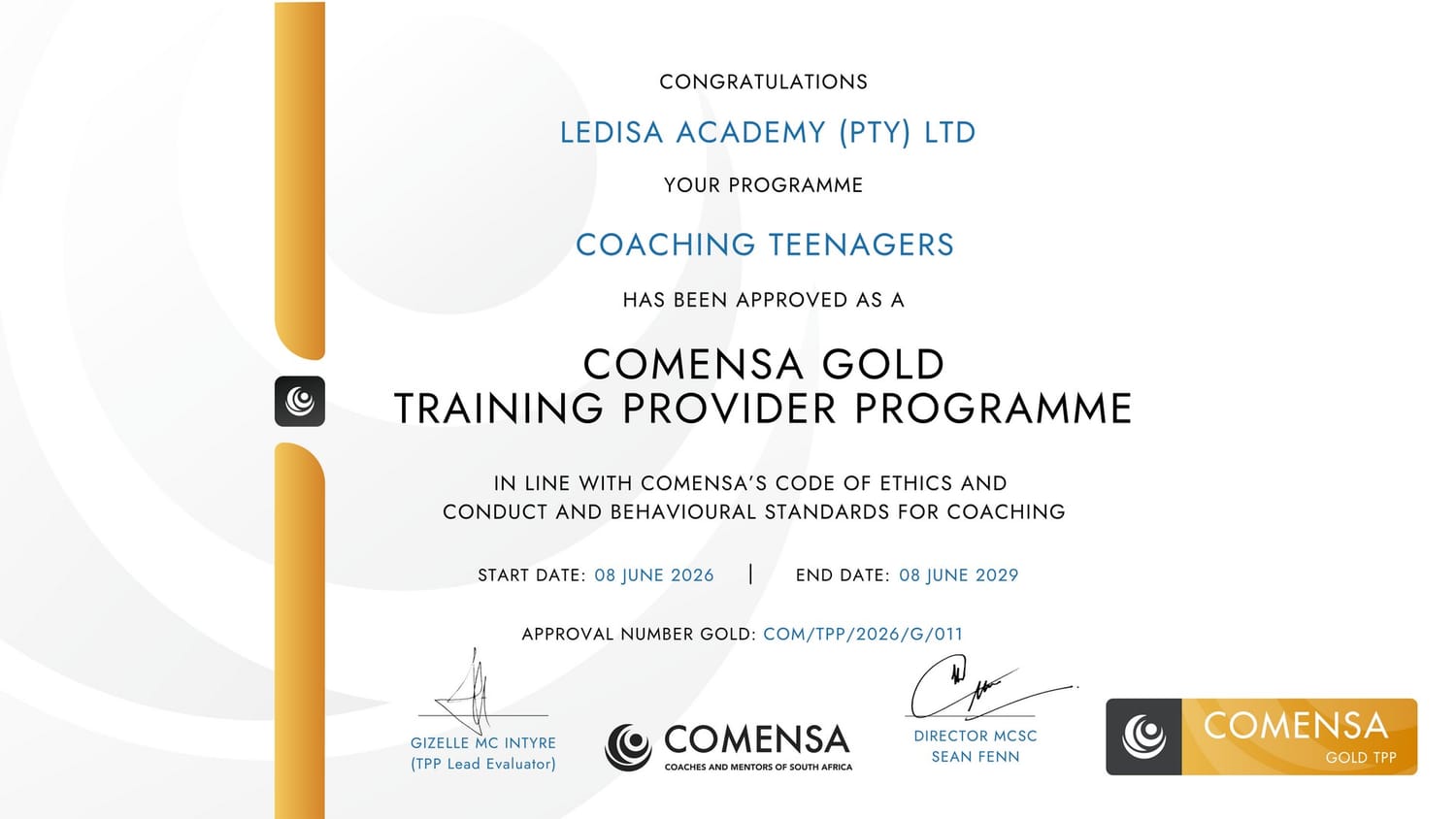
COMENSA Gold Training Programme registration - Coaching Teenagers
Who developed this programme
Coaching Teenagers was developed by Dr Leon Pienaar, founder of LEDISA Academy, Master Coach and Doctor of Pastoral Counselling, from years of training coaches, counsellors and helping professionals. It is built around practical coaching structure, ethical boundaries, parent communication, teen-sensitive tools, consent and assent, confidentiality, referral awareness and responsible practice.
Live sessions are facilitated by LEDISA Academy’s team of certified facilitators. Read more about LEDISA Academy.
Frequently asked questions
Yes. Coaching and counselling are different disciplines with different scopes. This programme teaches you to coach teenagers within a clearly defined coaching scope, and to recognise and refer what falls outside it.
No. Delegates who are not yet certified coaches join the first three Dynamic Life Coaching sessions as a free bonus, an introduction to coaching, before the twelve specialist sessions begin.
Ages 13 to 17, including what changes legally and practically when a client turns 18 part-way through a coaching programme.
Modules 7 and 10 cover this directly: recognising what sits beyond coaching, what your duty is, how to refer without damaging trust, and how to document it.
One live two-hour Zoom session per week for twelve weeks, plus your own study and the practical assignment.
LEDISA Academy is an accredited training provider with SAQA (ETDP SETA, Services SETA and TETA) and the International Coaches Register, a Registered Training Institute with COMENSA and a Gold Training Programme Provider. (COM/TPP/2026/G/011)

Resources & Information
Follow Us



© All rights reserved. 2026 - LEDISA Academy (Pty) Ltd.
Made with ❤ by LEDISA Design Studio